If you want to know how to become an electrician in Ontario, the good news is that the path is clear, well regulated and paid from day one. You earn while you learn, you finish with a certificate that is recognized across Canada, and skilled electricians stay in demand. The less exciting news is that the journey takes about five years and has several steps that must happen in the right order. This guide walks you through every stage so you can plan with confidence.
How to Become an Electrician in Ontario: What the Job Involves and Why It Is Regulated
Construction and maintenance electricians install, test and repair wiring, lighting, panels, motors and control systems in homes, schools, hospitals, offices and factories. The work affects the safety of everyone who uses those buildings, which is why the trade is taken seriously by the province.
In Ontario, Electrician – Construction and Maintenance (trade code 309A) is a compulsory trade. According to Skilled Trades Ontario, you must be a registered apprentice, hold a Provisional Certificate of Qualification or hold a Certificate of Qualification to work in the trade legally. In other words, you cannot simply pick up tools and start wiring buildings on your own.
Step 1: Meet the Basic Requirements
The first part of how to become an electrician in Ontario is meeting a few simple conditions. Skilled Trades Ontario lists Grade 10 as the education requirement for the 309A apprenticeship, although many colleges and employers prefer Grade 12 or equivalent because the training involves a fair amount of math and reading. Most programs also expect you to be at least 16 years old.
Good habits matter just as much as paperwork. Employers look for people who are reliable, comfortable with heights and tight spaces, and willing to follow safety rules every single day. If you enjoy problem solving and working with your hands, you are already ahead.
Step 2: Choose Your Starting Route
There is no single door into the trade, so how to become an electrician in Ontario depends partly on where you start. Most people begin in one of these ways:
- Pre-apprenticeship training: a short, school-based program that teaches safety, wiring basics and job readiness. It does not require a sponsor and can improve your chances of being hired.
- Direct hire: an electrical contractor hires you as a helper or apprentice and agrees to train you.
- High school co-op or OYAP: students can start accumulating experience before they graduate.
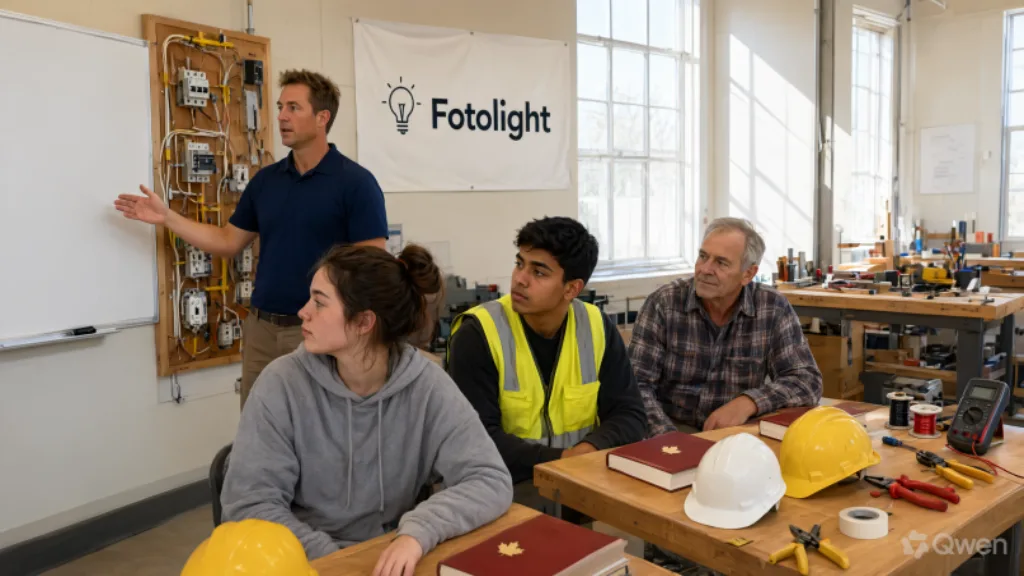
- Preparation courses: short classes that build Code knowledge early, such as the training program at Fotolight.
Hundreds of people apply for electrician apprenticeships every year, so anything that makes you stand out helps. A completed pre-apprenticeship, a clean safety record and a professional attitude all count.
Step 3: Find a Sponsor and Register With Skilled Trades Ontario
An apprenticeship is a paid job, not a classroom program. That means you need an employer, called a sponsor, who agrees to train you. Together you sign a Registered Training Agreement and register the apprenticeship with Skilled Trades Ontario. Your sponsor must be qualified to train apprentices, so it is worth asking about that before you sign. Understanding the sponsor relationship is a big part of how to become an electrician in Ontario without wasting time.
Once you are registered, Skilled Trades Ontario gives you the training standard for your trade. This document lists every task and skill you are expected to master over the length of the apprenticeship. Keep it safe, because you will use it for years.
Step 4: Log Your 9,000 Hours
The apprenticeship for Electrician – Construction and Maintenance is set at 9,000 hours, roughly five years. That total is made up of 8,160 hours of on-the-job training and 840 hours of in-school training.
On the job, you work under a licensed electrician who signs off on your skills as you learn them. Typical tasks include:
- Reading drawings, blueprints and specifications
- Installing conduit, cable, boxes and panels
- Terminating wires and testing circuits
- Installing lighting, motors and control equipment
- Troubleshooting faults safely
Log your hours and skills carefully, and have them signed regularly, because this record is the backbone of how to become an electrician in Ontario. Missing records are one of the most common reasons people lose time on the path to certification.
Step 5: Complete Your In-School Training
The 840 school hours are delivered in blocks, usually at a college, and are organized into levels. Ontario is introducing an updated curriculum for the electrical trades. Level 1 started on September 1, 2024, Level 2 followed on September 1, 2025, and Levels 3 and 4 are scheduled for September 1, 2026. Check with your training delivery agent to see which version applies to you.
In school you study electrical theory, the Canadian Electrical Code, calculations, blueprints, motors, controls and safety. Treat every level as practice for the final exam, because the material builds on itself.
Step 6: Prepare for and Pass the Certificate of Qualification Exam
When your hours and school levels are complete, you can apply to write the 309A Certificate of Qualification exam. The exam is multiple choice and gives you up to four hours to finish. It leans heavily on the Electrical Code, so learning how to find answers quickly in the Code book is a skill you should build early.
Smart preparation includes three habits:
- Study the Code book a little every week instead of cramming.
- Work through realistic questions, such as our 309A sample test and our collection of Red Seal electrician exam questions.
- Read the format guide in our 309A exam overview and the 309A license exam guide.
Passing the exam is the final checkpoint in how to become an electrician in Ontario, so give it proper attention. If your first attempt does not go the way you hoped, review your weak areas and try again. Many successful electricians needed more than one try.
Step 7: Keep Your Certificate Active and Keep Growing
After you pass, Skilled Trades Ontario issues your Certificate of Qualification. Because 309A is a compulsory trade, the certificate must be renewed to stay valid, and your name appears on the public register. From there you can work as a journeyperson, specialize in areas such as fire alarm or low voltage systems, move into estimating or supervision, or eventually start your own business.
How Much Can You Earn After You Become an Electrician in Ontario?
Money is a big part of how to become an electrician in Ontario for many people, so it helps to see realistic numbers. Wages depend on your region, your employer and your experience. The Government of Canada Job Bank reports hourly wages for electricians in Ontario ranging from about $20 at the low end to about $50.50 at the high end, with a median of $34 per hour. These figures were updated in November 2025, and rates in the Toronto region are similar. Apprentices earn a percentage of the journeyperson rate that rises as they progress.
Overtime, union agreements, industrial work and specialties can push earnings higher. Our team is always happy to talk about what the trade can realistically offer you.
Common Mistakes People Make When Learning How to Become an Electrician in Ontario
- Working without registration. Hours worked outside a registered apprenticeship may not count.
- Ignoring the Code book. The exam rewards people who can navigate it quickly.
- Waiting until the last minute to study. The exam covers years of material.
- Skipping safety training. It protects you and keeps you employable.
- Not asking for help. Mentors, instructors and study partners shorten the learning curve.
How Fotolight Can Support Your Journey
If you are still deciding how to become an electrician in Ontario, our classes give you a structured place to start. Fotolight offers a training program built around the Canadian Electrical Code, electrical safety, hands-on use of tools and equipment, and practice exams that mirror the real test. We also help students understand 309A registration and eligibility requirements, and graduates receive a Fotolight Certificate of Completion. Visit our 309A training page to learn more, or reach out through the contact page to ask about upcoming classes.
Quick Summary: How to Become an Electrician in Ontario at a Glance
If you only have a minute, here is how to become an electrician in Ontario in plain terms. You meet the entry requirements, find a sponsor, register with Skilled Trades Ontario, work and study for 9,000 hours, then pass the Certificate of Qualification exam. After that you renew your certificate and keep learning.
- Time needed: about five years of combined work and school.
- Money: you are paid as an apprentice while you train.
- Key exam: the 309A Certificate of Qualification, based heavily on the Electrical Code.
- Best early move: start learning the Code book now, because every serious guide on how to become an electrician in Ontario stresses it.
Tips for Getting Ahead While You Learn How to Become an Electrician in Ontario
Small choices early in your apprenticeship add up. Arrive early, ask questions and write down what you learn each day. A short notebook of lessons, Code rules and calculations becomes a priceless study tool when exam season arrives.
Build relationships with the journeypersons you work with. They decide how quickly you are exposed to new tasks, and they remember who was keen and careful. Look for chances to try different kinds of work, such as service calls, new construction and renovations, so your experience is broad.
Invest in good basic tools and keep them organized. Take safety training seriously, including working at heights, lockout and tagout, and first aid. These certificates make you more valuable and are part of any practical plan for how to become an electrician in Ontario safely.
Finally, study steadily. Thirty minutes a few evenings a week will take you further than a frantic month before the exam. Use practice questions, flash cards and study partners to keep the material fresh.
Is This Career Right for You?
The trade suits people who like practical problem solving, working in different locations and seeing the results of their work. It can be physically demanding, and the early years involve learning a lot of rules and procedures. However, the reward is a skilled, portable career with strong earning potential.
Before you commit to how to become an electrician in Ontario, try to spend a day with someone in the trade, or take a short introductory course. That small step will tell you quickly whether the daily reality matches your expectations. If it does, you will start your apprenticeship with confidence and a clear plan.
Frequently Asked Questions
How long does it take to become an electrician in Ontario?
The apprenticeship is set at 9,000 hours, which is about five years of combined on-the-job and in-school training, followed by the certification exam.
Can I become an electrician without an employer?
You can take pre-apprenticeship or preparation courses on your own, but to register an apprenticeship and log official hours you need a sponsoring employer.
Is the electrician exam hard?
It is demanding, mainly because of the Electrical Code content, but steady preparation with realistic practice questions makes a big difference.
Final Thoughts
Learning how to become an electrician in Ontario is mostly a matter of following the steps in order: meet the requirements, find a sponsor, log your hours, finish school, pass the exam and keep your certificate current. The path is long, but it is paid, respected and full of opportunity. Start building your Code knowledge early, choose training that fits your goals, and reach out when you need guidance.